How to Bet on NFL Games in the UK — Complete Guide 2026
 Available in US
Table of Contents
- Introduction
- What Every UK NFL Punter Needs to Know First
- The NFL Betting Market in the United Kingdom
- UKGC Licensing and What It Means for NFL Punters
- Core NFL Bet Types at a Glance
- Reading NFL Odds: Fractional, Decimal, and American
- In-Play NFL Betting in the UK
- Betting on NFL London Games
- Super Bowl Betting From the UK
- NFL Betting Strategy: Where to Start
- Bankroll Management Essentials
- How Streaming Is Changing NFL Betting
- Responsible Gambling: Data, Tools, and Support
- Frequently Asked Questions
By NFL Betting Analyst

Introduction
UK NFL Fanbase
13 million fans and growing
2025 Season Handle
$30 billion wagered through legal US books alone
UK Online Betting
290 million real-event bets placed every month
Nine years ago I placed my first NFL spread bet from a flat in South London, staring at a decimal odds format I barely understood and a Kansas City Chiefs game I’d picked based on nothing but a gut feeling. I lost. The next week I lost again. By week five I’d blown through a modest bankroll and learned something that no bookmaker promo page will ever tell you: NFL betting from the UK is a different animal than what American punters deal with, and if you don’t understand the differences — odds formats, regulatory framework, market timing — you’re handing money to bookmakers before the ball is even snapped.
This guide is built from those nine years of mistakes, adjustments, and eventually consistent results. The American Gaming Association pegged total legal NFL wagering at $30 billion for the 2025 season, an 8.5% jump from the year before. The NFL has more than 13 million fans on this side of the Atlantic — roughly 4 million of them self-described avid followers. There’s massive demand for NFL betting content tailored to British punters, and precious little of it that goes beyond a list of bookmaker logos and promo codes.
What follows is the guide I wish I’d had in 2017. Every claim is backed by a number, every strategy has been road-tested across multiple seasons, and the entire thing is written for someone who pays in pounds, reads odds in fractions, and watches games that kick off at 6pm on a Sunday evening. Whether you’re placing your first NFL wager or sharpening an approach that’s already profitable, the structure below will take you from market context through bet mechanics, London Games edges, Super Bowl markets, bankroll discipline, and responsible gambling — in that order, because that order matters.
What Every UK NFL Punter Needs to Know First
- The UK NFL betting market is large, liquid, and growing — over 13 million British fans, GBP16.8 billion in total UK gambling yield, and bookmaker coverage now stretching to hundreds of player props per game.
- Only UKGC-licensed operators offer deposit limits, self-exclusion via GamStop, and transparent dispute resolution — always verify a licence before funding an account.
- Point spreads, totals, and moneylines are the core bet types worth mastering first; parlays and exotic props carry higher margins and should be treated as entertainment, not strategy.
- Flat-staking 1-3% of your bankroll per wager is the single most effective risk control — it survives losing streaks and keeps you in the game long enough for edges to compound.
The NFL Betting Market in the United Kingdom
I remember trying to explain to a mate in 2018 that American football was going to be massive in Britain. He laughed. He’s not laughing now — the NFL counts over 13 million fans in the UK, with 68% of them aged 18 to 44, precisely the demographic that bookmakers build their mobile apps for. What was once a niche sport sandwiched between Match of the Day reruns has turned into a legitimate betting market with its own rhythms, its own edges, and its own pitfalls.
The broader UK gambling landscape sets the stage. The UK Gambling Commission reported a combined Gross Gambling Yield of GBP16.8 billion for the April 2024 to March 2025 period — a 7.3% rise year on year. Remote casino, betting, and bingo alone accounted for GBP7.8 billion of that total, claiming 46% of the entire market. Roughly 10% of the UK population now places sports bets online. These aren’t fringe figures. They describe an industry that’s woven into the fabric of British leisure, and the NFL is riding that wave harder than most sports outside football and horse racing.
When tickets for the first NFL games at Tottenham Hotspur Stadium went on sale in 2019, they sold out in 45 minutes — with 750,000 unsuccessful applications for a venue that seats around 62,000. That’s a 12-to-1 oversubscription ratio, the kind of demand most Premier League clubs would envy.
The growth trajectory isn’t accidental. In 2022, ITV signed a three-year deal with the NFL to broadcast games on free-to-air television across the UK and Ireland, removing the Sky Sports paywall for a chunk of the schedule. Bill Miller, President and CEO of the American Gaming Association, put it plainly: “This season, fans have more ways than ever to responsibly engage with the game they love. Legal sports betting enhances the fun and friendly competition that make NFL games and traditions even more special.” That sentiment translates directly to the UK — more eyeballs on games means more punters exploring the markets.
The UK sports betting market itself is projected to reach $21.3 billion by 2030, growing at a compound annual rate of 11.4%. NFL betting sits inside that growth curve, fuelled by three forces: expanding broadcast access, the annual London Games creating a tangible local connection, and a generation of British fans who grew up watching highlights on social media rather than waiting for Channel 4’s late-night American football slot. The search data backs this up — the UK accounts for about 3% of global NFL-related search traffic, with the Kansas City Chiefs drawing the highest share of British interest at 9.5% of UK queries.
ITV’s free-to-air NFL deal, running through the 2024 season and likely to be renewed or expanded, means that UK viewers can watch select regular-season and playoff games without a subscription. This is a significant shift from the Sky Sports-only era and directly increases casual fan engagement with NFL betting markets.
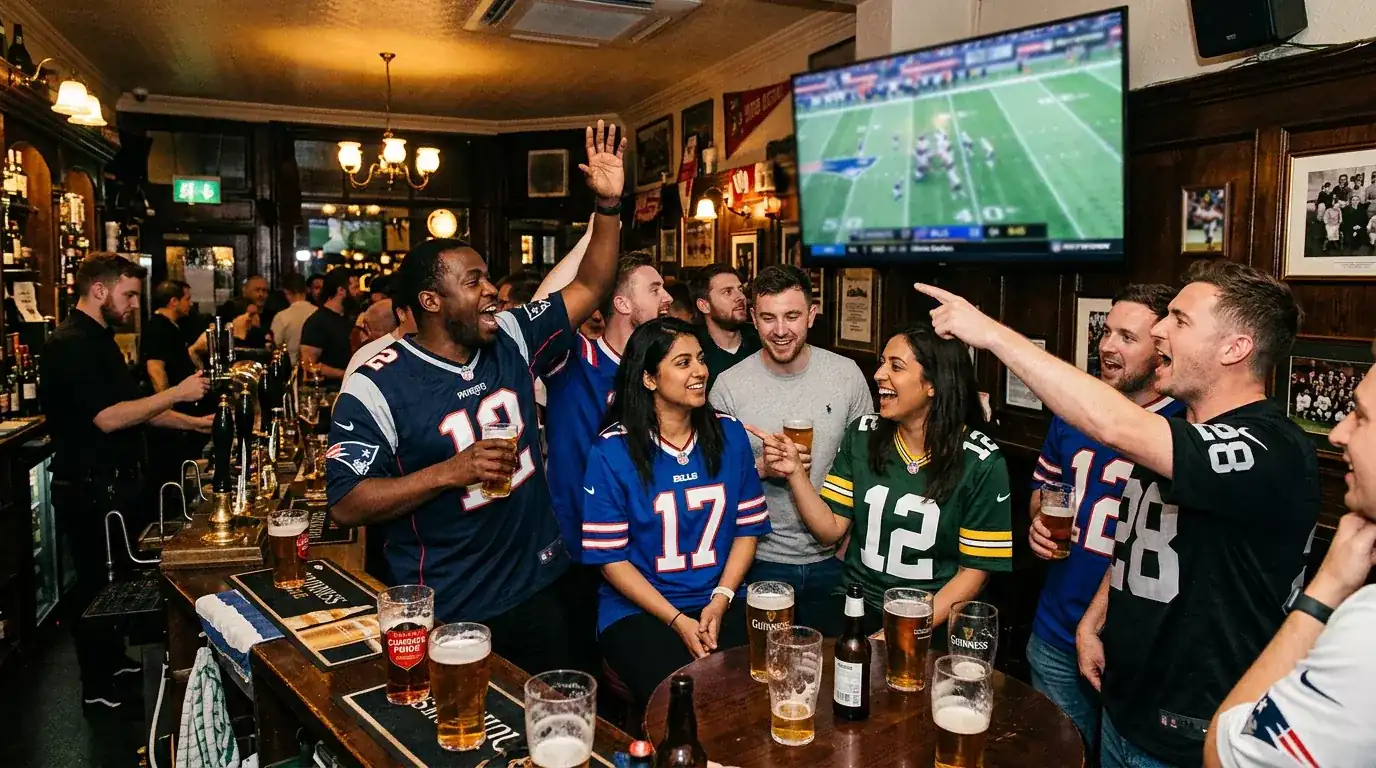
For punters, the practical implication is straightforward: the NFL betting market in the UK is deep enough for serious wagering, liquid enough to offer competitive odds on most game lines, and growing fast enough that bookmakers are actively expanding their American football coverage. Five years ago, finding player prop markets on a Week 8 Thursday night game would have been a struggle. Today, those markets open days in advance with hundreds of props available by kickoff. The infrastructure is there.
UKGC Licensing and What It Means for NFL Punters
The first NFL bet I ever voided taught me more about regulation than any policy document could. I’d signed up with an offshore operator offering inflated Super Bowl odds, placed a parlay, won — and then spent six weeks chasing a payout that never arrived. No recourse, no ombudsman, no protection. That experience converted me into someone who checks a UKGC licence number before checking the odds.
Non-negotiable first step: Before depositing a single pound with any bookmaker for NFL betting, verify that the operator holds a valid licence from the UK Gambling Commission. You can check any licence number directly on the UKGC’s public register. If it’s not there, walk away — no odds are good enough to justify betting with an unregulated operator.
The UK Gambling Commission exists to keep gambling fair, safe, and crime-free. For NFL bettors, that translates into concrete protections: your funds must be segregated from the operator’s business accounts, dispute resolution mechanisms are mandatory, and the bookmaker must offer responsible gambling tools including deposit limits, cooling-off periods, and self-exclusion via GamStop. The UKGC reported 13.5 million active online betting accounts per month as of late 2024/25, with online GGY climbing 7% in Q4 to GBP1.45 billion. Those accounts are protected by the regulatory framework — accounts with unlicensed operators are not.
The responsible gambling dimension is particularly relevant for a sport like the NFL, where the weekly schedule creates a natural rhythm of anticipation, wagering, and outcome. Tim Miller, Executive Director of Research and Policy at the UK Gambling Commission, noted that while participation has grown, the percentage of those scoring four or more on the youth-adapted problem gambling screen “has not increased but has moved from 1.5% last year to 1.2% this year, which is classed as statistically stable.” Stability is good news, but it doesn’t mean the tools are optional. UKGC-licensed operators are required to provide reality checks, session time alerts, and easy access to support organisations like GamCare and the National Gambling Helpline.
GamStop is the UK’s free self-exclusion scheme covering all UKGC-licensed online gambling operators. If you register with GamStop, every licensed bookmaker is legally required to block your account. GamCare provides free counselling, advice, and support for anyone affected by problem gambling. Both services operate independently of any bookmaker.
One detail that catches out American football fans moving from US-based content to UK betting: the regulatory environments are fundamentally different. In the US, sports betting regulation is a state-by-state patchwork. In the UK, the framework is national. Any UKGC-licensed bookmaker can legally offer NFL markets to anyone in England, Scotland, Wales, and Northern Ireland.
Core NFL Bet Types at a Glance
Walk into any NFL betting market as a newcomer and you’ll be hit with a wall of terminology that sounds designed to confuse. Spread, moneyline, totals, props, futures, parlays — each word represents a different way to stake money on a game, and each carries a different risk profile. I spent my first season betting nothing but moneylines because I didn’t understand spreads, and I left money on the table every single week. Here’s how the six core bet types work, translated for punters who think in fractional odds and know the word “accumulator” better than “parlay.”
Spread — a handicap applied to the favoured team. The favourite must win by more than the spread for a spread bet to pay out.
Moneyline — a bet on which team wins outright, no handicap involved.
Totals (Over/Under) — a bet on whether the combined score of both teams exceeds or falls short of a set number.
Parlay (Accumulator) — a combined bet where every leg must win for the bet to pay out.
Prop (Proposition) — a bet on a specific event within a game, such as a player’s passing yards or the first team to score.
Futures — a long-term bet on an outcome decided later in the season, such as the Super Bowl winner.
Point Spreads
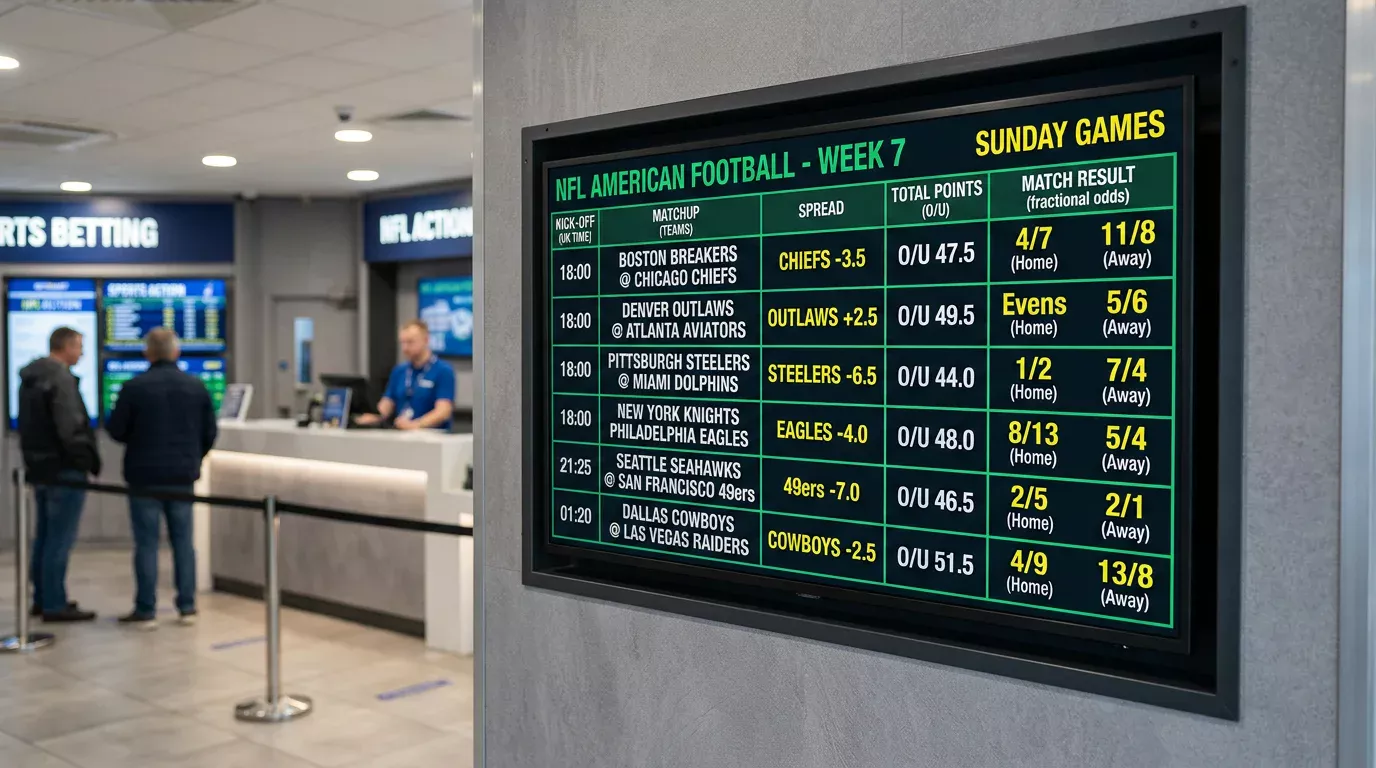
The spread is the backbone of NFL betting. If the Chiefs are listed at -3.5 against the Ravens, the Chiefs need to win by four or more points for a spread bet on them to land. Backing the Ravens at +3.5 means they can lose by up to three points and your bet still pays. The half-point eliminates the possibility of a push — a drawn result against the spread.
Example: Chiefs -3.5 vs Ravens +3.5
You back the Chiefs at -3.5 with a GBP20 stake at odds of 10/11 (1.91 decimal).
Final score: Chiefs 27, Ravens 21. Margin = 6 points. The Chiefs covered.
Payout: GBP20 x 1.91 = GBP38.20 (profit of GBP18.20).
If the final score had been Chiefs 24, Ravens 22 (margin = 2), the bet loses.
For a deeper breakdown of key numbers like 3 and 7, alternate spreads, and ATS records at UK bookmakers, the point spread explained guide covers it in full.
Moneylines
A moneyline bet strips away the handicap entirely — you’re picking which team wins. The catch is in the price: heavy favourites carry short odds that require large stakes for modest returns, while underdogs offer bigger payouts but win less often. Moneylines are most useful in tight games where the spread is 1 to 2.5 points, because the odds difference between the two markets narrows enough to make the outright winner bet viable.
Totals — Over/Under
Totals betting asks one question: will the combined final score land over or under a line set by the bookmaker? A total of 47.5 on a game between two pass-heavy offences might look like an obvious over, but weather, defensive matchups, and game script all factor in. Totals suit punters who have a strong read on the pace and style of a game but no conviction on who wins it.
Parlays and Accumulators
In UK betting language, a parlay is an accumulator — a combined bet where every leg must win. The appeal is obvious: link three or four selections and the combined odds can turn a GBP10 stake into a GBP200 payout. The reality is less glamorous. Parlay bets accounted for 22% of total handle at US bookmakers in 2024, but the average hold rate exceeded 15% — meaning bookmakers keep a far bigger slice of parlay money than they do on straight bets. I use parlays sparingly, and only when I’ve identified genuinely uncorrelated outcomes.
Player and Game Props
Props break a game into its component parts. Player props cover individual statistical outcomes — passing yards, rushing touchdowns, receptions — while game props focus on events like “first team to score” or “will there be a safety.” The NFL generates more prop markets than any other sport because every drive, every possession, every snap creates a discrete event that bookmakers can price. Props are where preparation meets opportunity, particularly on player stat lines where you’ve done more research than the odds compiler.
Futures
A futures bet locks in your position on an outcome that won’t be decided for weeks or months — Super Bowl winner, conference champion, division winner, league MVP. The key variable is timing: futures odds shift constantly as the season unfolds, and the best value often appears when public perception hasn’t caught up with on-field performance. A team that starts 1-3 but has favourable underlying metrics might be available at 40/1 when the true probability is closer to 20/1.
| Bet Type | What You’re Betting On | Best For |
|---|---|---|
| Point Spread | Margin of victory relative to the handicap | Experienced punters who analyse matchups closely |
| Moneyline | Which team wins outright | Tight games where the spread is small |
| Totals | Combined score over or under a set line | Punters with a read on game pace and conditions |
| Parlay / Acca | Multiple selections combined | Selective use with uncorrelated legs |
| Props | Specific player or game events | Those willing to research individual matchups |
| Futures | Season-long outcomes | Patient bettors who spot value early |
Reading NFL Odds: Fractional, Decimal, and American
Here’s something that tripped me up for longer than I’d like to admit: I’d read an American betting blog recommending a play at “-110,” open my UK bookmaker, see “10/11,” and have no idea whether I was looking at the same thing. The answer is yes — 10/11 fractional, 1.91 decimal, and -110 American all represent roughly the same price. But if you can’t move fluidly between the three formats, you’ll struggle to follow any cross-Atlantic analysis, and you’ll miss value when comparing lines across platforms that default to different displays.
| Format | Example | What It Tells You | Implied Probability |
|---|---|---|---|
| Fractional | 10/11 | Stake GBP11 to profit GBP10 | 52.4% |
| Decimal | 1.91 | Total return of GBP1.91 per GBP1 staked | 52.4% |
| American | -110 | Stake $110 to profit $100 | 52.4% |
Fractional odds are the native format for British punters. They express profit relative to stake: 5/1 means GBP5 profit for every GBP1 wagered. Decimal odds, more common in continental Europe and increasingly popular on UK platforms, show the total return including your stake: 6.00 decimal is the same as 5/1 fractional. American odds use a baseline of 100 — negative numbers tell you how much to stake for $100 profit (favourite), and positive numbers show profit from a $100 stake (underdog).
Converting American odds to fractional
American odds: -150 (favourite).
Step 1: Divide 100 by the number (ignoring the minus sign). 100 / 150 = 0.667.
Step 2: Express as a fraction. 0.667 = roughly 2/3.
So -150 American = 2/3 fractional = 1.67 decimal.
For positive American odds (underdog): +200.
Step 1: Divide the number by 100. 200 / 100 = 2.
Step 2: Express as a fraction. 2 = 2/1.
So +200 American = 2/1 fractional = 3.00 decimal.
The conversion matters because implied probability is the real language of odds. Every price carries a built-in assumption about how likely an outcome is. At 10/11 (1.91), the implied probability is 52.4%. If your own analysis suggests the true probability is 57%, you’ve found value — the bookmaker is underestimating the chance, and over a large enough sample, betting at that price should produce a positive return. Every odds format encodes the same information; your job is to decode it, compare it against your assessment, and act only when the gap is in your favour.
Gridiron Bet Toolkit
Odds conversion, spread cover checks, and bankroll projections — the maths behind this guide, run on your own numbers.
Check whether a spread bet covers, then see how much of a normal home spread is really just home-field advantage — the part that disappears at a neutral-site London Game.
London Game neutral-venue adjuster
Most UK bookmakers let you toggle between formats in the app settings. I keep mine on decimal for quick mental arithmetic — multiplying the stake by the decimal price gives an instant total return — but switch to fractional when comparing traditional UK markets. Whichever format you prefer, the ability to convert between all three is non-negotiable if you’re consuming NFL betting content from both sides of the Atlantic.
In-Play NFL Betting in the UK
The game that changed my approach to live betting was a 2022 Sunday night contest where the trailing team scored 17 unanswered points in the fourth quarter. I’d taken the live spread on the comeback side at +14.5 during a commercial break, and by the time the dust settled, I’d covered by a comfortable margin. That’s the promise of in-play NFL betting — reacting to what’s actually happening on the field rather than what you thought would happen three hours earlier.
Live betting already dominates European football markets, where in-play wagers account for more than 60% of all online bets. The NFL hasn’t reached that level yet, but the trajectory is unmistakable. The structural appeal is obvious: an NFL game unfolds in discrete chunks — drives, possessions, quarters — each of which creates a natural recalibration point for odds. When a starting quarterback leaves with an injury in the second quarter, the live spread might shift by three to five points within seconds. If you’ve done the prep work on the backup quarterback’s track record, that shift is an opportunity.
NFL live markets typically include adjusted spreads, moneylines, and totals that update on a drive-by-drive basis. Some UK bookmakers also offer in-play props such as “next team to score,” “next scoring method,” and drive-result markets. The depth of live coverage varies significantly between platforms — it’s worth testing several before the season starts.
The technology underpinning live NFL odds is evolving fast. DraftKings acquired Simplebet, an AI-powered micro-betting company, in August 2024 specifically to expand real-time wagering with predictions generated on every single play. The implications for punters are double-edged: AI-driven odds adjust more quickly and more accurately than human-compiled lines, which means the window for exploiting inefficiencies during a live game is narrower than it was even two years ago. For a detailed breakdown of timing strategies, cash-out mechanics, and the pitfalls of chasing momentum shifts, the in-play NFL betting guide walks through it step by step.
Mobile betting accounts for 78% of all online sports wagers globally. For NFL live betting, that figure is likely even higher — the nature of in-play wagering demands the ability to place bets from the sofa, the pub, or the stands at Tottenham Hotspur Stadium in real time.
One caution I’ll flag from personal experience: the pace of NFL live betting can erode discipline faster than any other market. A bad pre-game bet followed by two losing in-play wagers creates a compounding sense of urgency to “get it back” before the final whistle. I’ve been there. The antidote is a strict live-betting budget that’s separate from your pre-game bankroll, with predefined exit points — a rule I’ll expand on in the strategy and bankroll sections that follow.
Betting on NFL London Games
There’s a particular thrill in betting on NFL games played on your home soil. I’ve been at Tottenham Hotspur Stadium for three London Games now, and each time the atmosphere is unlike anything else in British sport — 62,000 people who’ve waited all year for this, in a venue purpose-built with a retractable grass pitch over an artificial NFL surface underneath. It’s also one of the few NFL betting scenarios where UK punters can claim a genuine informational edge over the American market.
The history runs deeper than most people realise. The NFL’s first regular-season game in London took place in 2007, and since then more than 33 international games have been staged in the city across Wembley and Tottenham Hotspur Stadium. Roger Goodell has been explicit about the long-term vision: “We’re not looking to be a circus when we go in. We want to be there. We want to put roots in there.” The commissioner’s stated goal is 16 international games per season, one for every NFL team, spread across multiple countries. The 2025 season already featured a record seven international fixtures — three in London, plus games in Dublin, Berlin, Madrid, and Sao Paulo.
Favourites have won 65.6% of London Games historically — virtually identical to the standard NFL rate of roughly 66%. The notion that London Games are unpredictable upsets is a myth. The data says the spread behaves normally; the betting angles lie elsewhere.
Neutral venue matters. Neither team has a home-field advantage in London. Both squads travel roughly the same transatlantic distance, face the same jet-lag disruption, and play in front of a crowd that’s broadly neutral. This removes one of the most significant variables in NFL handicapping — home-field advantage, historically worth about 2.5 to 3 points on the spread. When you’re evaluating a London Game spread, you’re looking at a structurally different proposition than a standard Week 7 matchup in Kansas City or Philadelphia.
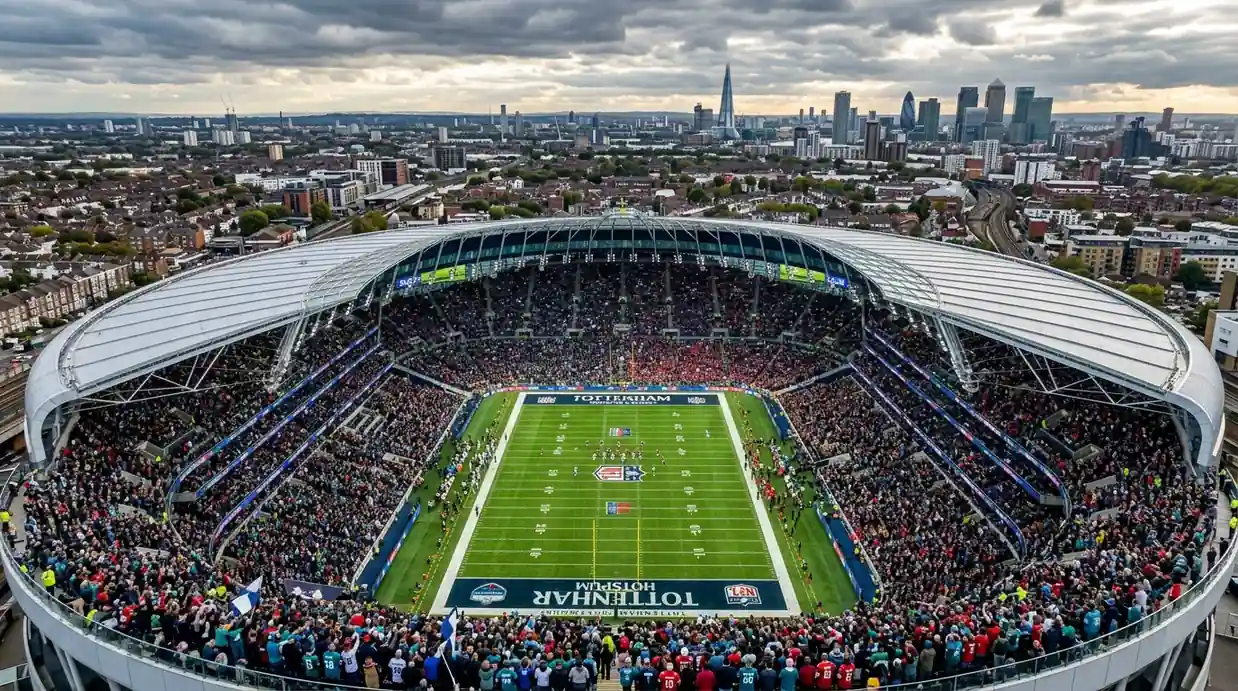
The travel and jet-lag factor cuts both ways. Teams that arrive in London early in the week tend to acclimatise better, and their performance data reflects it. Some franchises treat the London trip as a team-bonding exercise; others fly in late and look sluggish at kickoff. Goodell himself has acknowledged the learning curve, noting that “there are markets that could certainly support a team” while emphasising the need to manage competitive consequences. For bettors, tracking each team’s travel schedule and London preparation approach is a tangible edge that the American market often ignores.
If you’re attending a London Game in person, the betting dimension adds another layer. UK bookmakers typically run enhanced promotions around international games, and watching the action live — without a streaming delay — gives in-play bettors a fractional timing advantage. For a full breakdown of ATS records, travel patterns, and over/under trends in international fixtures, the London Games betting analysis digs into the numbers game by game.
Super Bowl Betting From the UK
Every February, my phone buzzes with messages from people who haven’t watched a single NFL game all season asking me for Super Bowl picks. The game is a cultural event that transcends the sport — 124.9 million average international viewers tuned in for Super Bowl LX — and for UK punters, it represents the single most concentrated betting opportunity of the year.
Super Bowl LX Handle
$1.76 billion through legal US bookmakers
Global Viewership
124.9 million average international viewers
The numbers are staggering. The AGA estimated $1.76 billion in legal wagers on Super Bowl LX alone — a 27% year-on-year increase. Bill Miller captured the scale perfectly: “No single event brings fans together like the Super Bowl, and this record figure shows just how much Americans enjoy sports betting as part of the experience.” That enthusiasm crosses the Atlantic in full force. UK bookmakers open Super Bowl markets weeks in advance, offering everything from the standard spread and moneyline to hundreds of prop bets spanning the game, the halftime show, the coin toss, and the national anthem.
The Chiefs vs Cowboys Thanksgiving Day game in 2025 drew 57.2 million viewers — the most-watched regular-season NFL game in history. Yet the Super Bowl routinely doubles that audience. For bookmakers, the Super Bowl generates more single-event handle than any other fixture in global sport.
The practical challenge for UK punters is timing. The Super Bowl typically kicks off between 11pm and midnight UK time, meaning you’re watching well into Monday morning. This isn’t just an inconvenience — fatigue and the social atmosphere of a Super Bowl party cloud judgment. I’ve learned to place my core bets — spread, totals, and one or two researched props — before 10pm, then treat the live markets during the game as entertainment rather than serious wagering.
Super Bowl prop markets deserve special attention because they’re unlike anything else in the NFL calendar. Standard player props (passing yards, rushing touchdowns) sit alongside novelty markets — length of the national anthem, colour of the Gatorade shower, first song of the halftime show. The novelty props are fun, but they’re essentially coin flips with thin information edges. The serious value, in my experience, lives in player and game props where your research into the two specific teams can identify lines that the bookmaker has set based on season-wide averages rather than matchup-specific analysis. For a deeper look at prop categories, novelty wagers, and futures timing, the Super Bowl betting guide breaks it all down.
NFL Betting Strategy: Where to Start
I once tracked every bet I placed across an entire NFL season on a spreadsheet — 247 wagers over 18 weeks. The exercise was humbling. My win rate on spread bets was 53.8%, just above the break-even threshold of roughly 52.4% needed at standard juice. My moneyline win rate was higher, but the ROI was lower because I’d been backing heavy favourites at short prices. The parlays? Negative expected value across the board, as they are for almost everyone who’s honest enough to track them. That spreadsheet became the foundation of every strategic decision I’ve made since.
NFL betting produces more total handle than any other sport in the US — a single Sunday slate generates a bigger handle than entire weeks of baseball or basketball. That liquidity creates efficient markets, which means edges are small and fleeting. Strategy isn’t about finding a secret formula; it’s about stacking marginal advantages consistently over a long season.
Do
- Set a season bankroll before Week 1 and divide it into units — your risk per bet should be fixed before emotions enter the picture
- Shop lines across multiple bookmaker accounts — a half-point difference on a spread matters over hundreds of bets
- Track every wager with the same rigour you’d apply to a financial portfolio: stake, odds, result, closing line value
Don’t
- Chase losses by doubling your next stake after a losing Sunday — the maths guarantees this accelerates ruin
- Rely exclusively on parlays as your primary bet type — the bookmaker’s hold rate on accumulators is roughly double that on straight bets
- Bet based on narrative (“this team is due” or “they always win primetime games”) without checking whether the data supports the story

The three pillars of a workable NFL strategy are bankroll management, line shopping, and situational handicapping. Bankroll management is covered in the next section. Line shopping means holding accounts with several UKGC-licensed bookmakers and comparing prices before placing any bet — the differences might seem trivial on a single wager, but across a season they compound into the gap between a winning and losing record. Situational handicapping examines context beyond the headline numbers: bye weeks, short weeks, travel schedules, divisional rivalries, and weather forecasts.
For punters ready to go deeper into each of these pillars — including the Kelly Criterion, late-season situational spots, and a framework for reviewing your performance mid-season — the NFL betting strategy guide lays out each principle with worked examples and historical data.
Strategy without bankroll discipline is just theory. The next section turns principles into practical arithmetic.
Bankroll Management Essentials
Let me give you the single most boring sentence in this entire guide, and also the most important one: decide how much you can afford to lose over an NFL season, and never exceed it. That’s the whole philosophy. Everything else — unit sizing, staking models, drawdown limits — is just engineering around that core principle.
The American Gaming Association’s framing is worth borrowing here: “With strong consumer protections and a shared commitment to responsibility, the legal, regulated sports betting industry encourages all football fans to have a game plan before placing a bet and ensure their gameday experience — regardless of the outcome of a bet or the game — remains enjoyable.” Having a game plan means having a number. Not a vague “I’ll bet what feels right” but a hard GBP figure for the season.
Flat-betting example: GBP500 season bankroll, 2% unit size
Unit = GBP500 x 0.02 = GBP10 per bet.
After 100 bets at a 54% win rate with average odds of 1.91 (10/11):
Wins: 54 x GBP10 x 0.91 = GBP491.40 profit. Losses: 46 x GBP10 = GBP460.00 lost.
Net: +GBP31.40 (6.3% ROI). Your bankroll grows from GBP500 to GBP531.40 — modest but positive, and you were never at risk of ruin.
Flat betting — risking the same fixed amount on every wager — is the simplest and most resilient staking model. It won’t optimise growth as aggressively as percentage staking or the Kelly Criterion, but it’s nearly impossible to blow up your bankroll with it. For a first or second season of serious NFL betting, flat betting at 1-3% of your bankroll per bet is the approach I recommend unconditionally.
Pre-season bankroll setup
- Set a total season bankroll that you can lose in full without affecting your finances, relationships, or wellbeing
- Divide the bankroll into units of 1-3% — this is your maximum stake per bet for the entire season
- Open accounts with at least three UKGC-licensed bookmakers for line-shopping flexibility
- Create a tracking system — spreadsheet, app, or notebook — that logs every wager with date, market, stake, odds, and result
- Set a loss limit: if your bankroll drops by 50% at any point in the season, stop betting and review your approach before continuing
The temptation to deviate from your unit size is strongest after a losing streak — exactly the moment when discipline matters most. A GBP30 billion NFL betting market doesn’t care about your personal losing run. The odds reset every game. Your job is to still be solvent and clear-headed when Week 14 rolls around and the line you’ve been waiting for all season finally appears.
How Streaming Is Changing NFL Betting
Three years ago, if you wanted to watch Thursday Night Football live in the UK, you needed a Sky Sports subscription. Today, Amazon Prime Video carries the entire TNF package, and by mid-2025 the platform had logged 96.8 million unique viewers for the season — double-digit growth from the previous year. YouTube holds Sunday Ticket. ITV broadcasts select games on free-to-air. The NFL’s broadcast landscape has fragmented across streaming platforms, and that fragmentation is reshaping how UK punters engage with live betting markets.
UK NFL broadcast map 2025-26: Sky Sports carries the bulk of Sunday and playoff coverage. ITV shows select free-to-air games under its multi-year NFL deal. Amazon Prime Video streams Thursday Night Football exclusively. NFL Game Pass (via DAZN in some markets) offers a comprehensive package including RedZone. YouTube Sunday Ticket provides an additional option for out-of-market games.
The connection between streaming access and betting volume is direct. NFL regular-season viewership averaged 18.7 million per game in 2025 — the highest since 1989, a 10% increase over the previous year. More viewers means more informed bettors, which means more liquid markets, which means tighter spreads and faster line movements. For the UK punter, the practical consequence is that you now have more live-watching options than ever, which supports more informed in-play wagering — but it also means the market is more efficient because everyone else is watching too.
There’s a subtlety experienced live bettors understand: streaming delay. A live broadcast runs roughly 5-15 seconds behind real time, and streaming platforms can add another 10-30 seconds. If you’re placing in-play bets based on what you’re watching, the bookmaker’s odds model — driven by a real-time stadium data feed — has already priced in the play you just saw. Base your in-play decisions on pre-game analysis and game-flow patterns rather than trying to react to individual plays faster than the algorithm.
The ITV deal deserves particular attention for UK punters. Free-to-air NFL coverage exposes the sport to a casual audience that Sky Sports never reached, and that exposure is feeding the pipeline of new NFL bettors who start with a Super Bowl flutter and gradually move into regular-season wagering. The NFL’s UK fanbase didn’t grow into a major market by accident — broadcast accessibility is the engine, and streaming is the accelerant.
Responsible Gambling: Data, Tools, and Support
I nearly didn’t include this section. Not because it’s unimportant — the opposite. I nearly didn’t include it because every other NFL betting guide I’ve read treats responsible gambling as a legal obligation rather than a genuine conversation, tacking a generic disclaimer at the bottom and moving on. That approach is worse than useless. It’s dishonest. So here’s what the data actually says, and what tools actually work.
The number that should stop you scrolling: 2.7% of the UK adult population — roughly 1.4 million people — score 8 or higher on the Problem Gambling Severity Index. That’s not “at risk.” That’s problem gambling. If you recognise yourself in that statistic, the rest of this guide is irrelevant until you’ve spoken to someone who can help.
The broader participation data provides context. A UK Gambling Commission survey found that 48% of British adults had gambled within the previous four weeks, dropping to 27% when you exclude the National Lottery. Among those, 15% of men and 4% of women place sports bets. The NFL’s weekly rhythm — anticipation building from Monday through Saturday, a concentrated Sunday slate, then a results-and-recriminations cycle — creates a pattern that can be particularly difficult to break for anyone who’s struggling.
Anna Isaacson, SVP of Social Responsibility at the NFL, has framed the league’s position clearly: “We have a very long history of supporting critical societal issues, and accommodating responsible gambling is an issue that we know is impacting people all across the country.” That’s an American context, but the principle translates to the UK market without modification. Responsible gambling isn’t an afterthought; it’s a precondition for everything else in this guide having any value.
Warning signs to watch for
- Betting more than you can afford to lose, or borrowing money to fund bets
- Chasing losses by increasing stakes or placing impulsive in-play bets after a losing run
- Feeling anxious, irritable, or distracted when you’re not betting or can’t access your bookmaker app
- Lying to family or friends about how much time or money you’re spending on gambling
Where to get help
- GamStop — free self-exclusion from all UKGC-licensed online gambling sites for a chosen period
- GamCare — free confidential advice, counselling, and support via phone, chat, or in person
- National Gambling Helpline — 0808 8020 133, available 24 hours a day, 7 days a week
- Your bookmaker’s own tools: deposit limits, session time limits, reality checks, and temporary account blocks are available at every UKGC-licensed operator
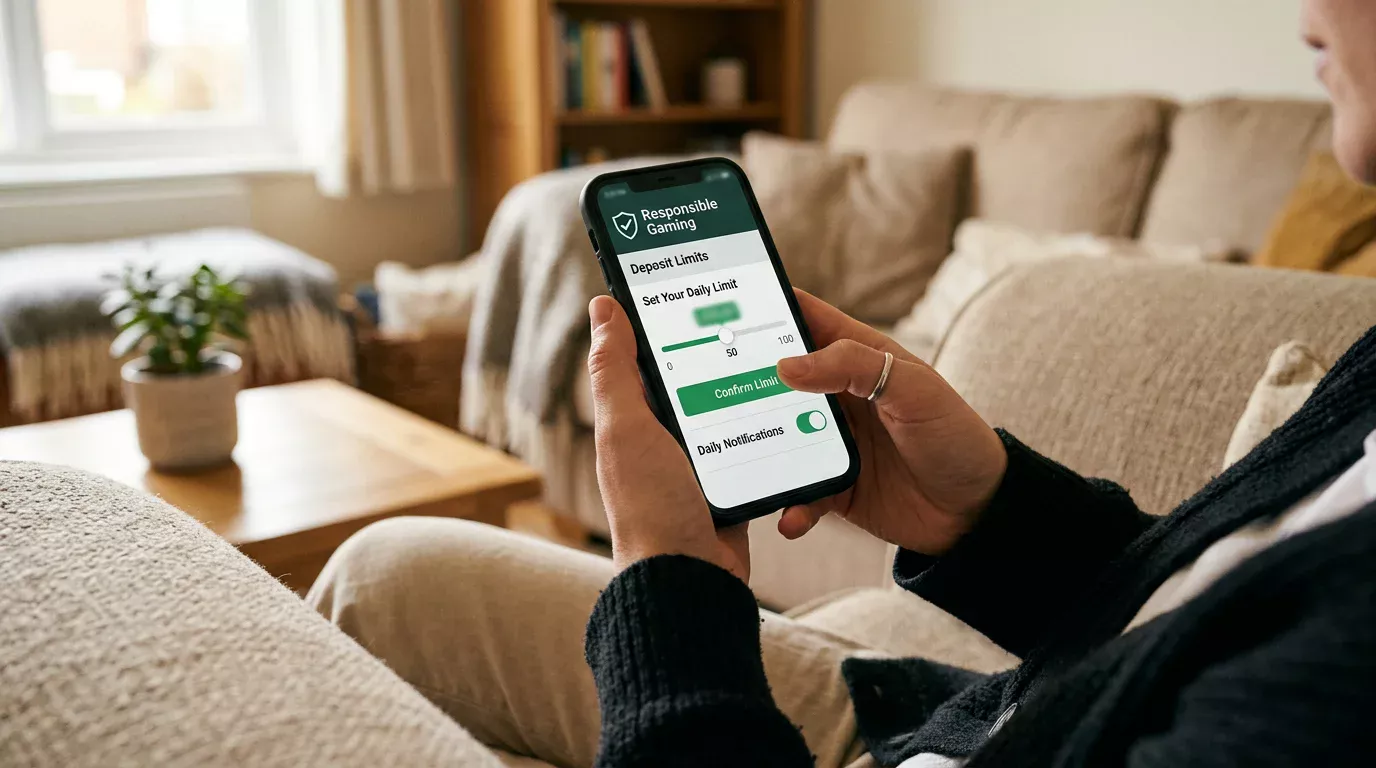
Tim Miller of the UK Gambling Commission noted that youth problem gambling rates have remained “statistically stable” even as overall participation has grown. Stability is better than increase, but stable at 1.2% still means thousands of young people are affected. If you’re reading this guide as someone new to NFL betting, build the safeguards in from the start: set your deposit limits on day one, activate reality checks, and treat your bankroll cap as a hard ceiling rather than a suggestion. The bet that matters most is the one you don’t place when you know you shouldn’t.
Frequently Asked Questions
Is NFL betting legal in the United Kingdom?
Yes. Betting on the NFL is fully legal in the UK provided you use a bookmaker licensed by the UK Gambling Commission. The UKGC regulates all commercial gambling in Britain under a single national framework — there’s no county-by-county or region-by-region variation as there is in the United States. You can verify any bookmaker’s licence status on the UKGC’s public register before opening an account.
What types of bets can I place on NFL games from the UK?
UK bookmakers offer the full range: point spreads, moneylines, totals (over/under), parlays (accumulators), player and game props, and futures on outcomes like the Super Bowl winner or league MVP. Market depth varies between bookmakers — some offer hundreds of individual prop markets per game, while others focus on core lines. Live (in-play) betting is widely available, with odds updating on a drive-by-drive basis.
How do NFL point spreads work?
A point spread is a handicap applied to the favoured team. If a team is listed at -3.5, they must win by four or more points for a spread bet on them to pay out. The opposing team at +3.5 can lose by up to three points and still cover the spread. The half-point (.5) eliminates the possibility of a push — a tied result against the spread. Spreads are the most popular NFL bet type among experienced punters because they equalise the value proposition between mismatched teams.
When does the NFL season start and end, and when can I bet?
The regular season runs from early September to mid-January, spanning 18 weeks with each team playing 17 games. Playoffs begin in mid-January and conclude with the Super Bowl in early February. Futures markets — Super Bowl winner, division champions, MVP — typically open within days of the previous Super Bowl. Regular-season game lines usually appear the week before each matchup.
How do I convert American odds to fractional or decimal odds?
For negative American odds (favourites): divide 100 by the number and express the result as a fraction. Example: -150 becomes 100/150, which simplifies to 2/3 fractional or 1.67 decimal. For positive American odds (underdogs): divide the number by 100. Example: +200 becomes 200/100, which is 2/1 fractional or 3.00 decimal. Most UK bookmaker apps let you toggle between fractional, decimal, and American formats in the settings, but understanding the conversion is essential for following American betting analysis.
Can I bet on NFL games live (in-play) at UK bookmakers?
Yes. Most major UKGC-licensed bookmakers offer in-play NFL betting with markets that update in real time during games. Available live markets typically include adjusted spreads, moneylines, totals, and selected props. The depth and speed of live markets varies between platforms — some update on every play, while others recalibrate at natural breaks like end of drives or quarters. Cash-out options are available on many in-play bets, though the terms and availability differ by bookmaker.
What responsible gambling tools are available to UK NFL bettors?
Every UKGC-licensed bookmaker must provide deposit limits, loss limits, session time limits, and reality check alerts. GamStop is a free national self-exclusion scheme that blocks access to all UKGC-licensed online gambling sites for 6 months, 1 year, or 5 years. GamCare provides free confidential counselling and support. The National Gambling Helpline (0808 8020 133) operates 24/7. These tools work best when set up proactively — before you need them.
Created by the ”bet nfl Games” editorial team.